
Lazertinib
Lazertinib is an oral, brain-penetrant, mutant-selective third-generation EGFR tyrosine kinase inhibitor that targets activating and T790M resistance mutations in EGFR-mutated NSCLC.
DEVELOPMENT STAGE
Approved & Commercialized — U.S. · EU · Japan · China · Korea
Commercialized
AT A GLANCE
Target
Mutant EGFR
EGFR with exon 19 deletions, L858R, or T790M mutations
INDICATION
EGFR-mutated NSCLC
First-line treatment in combination with amivantamab
MODALITY
Small molecule
Oral, brain-penetrant, mutant-selective EGFR TKI
Persistent resistance in EGFR-mutated NSCLC provided a rationale for complementary EGFR/MET targeting strategy
First- and second-generation EGFR inhibitors improved outcomes in EGFR-mutant NSCLC, but most patients eventually developed acquired resistance, frequently driven by the T790M mutation. A next-generation therapy was therefore needed to retain potent activity against common activating EGFR mutations, including exon 19 deletions and L858R, while also targeting T790M-mediated resistance. Improved selectivity over wild-type EGFR was also needed to reduce class-related toxicity, together with effective CNS penetration to better control brain metastases. These limitations defined the need for a mutant-selective, brain-penetrant third-generation EGFR inhibitor.
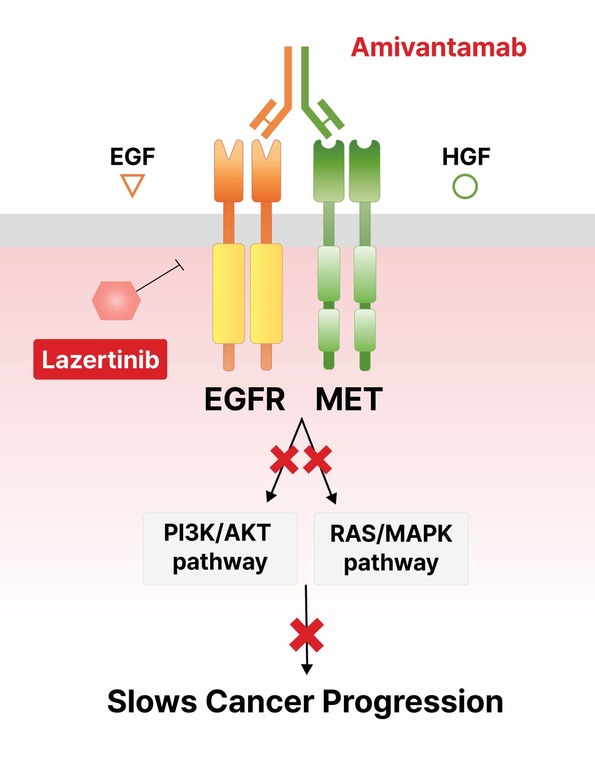
Even with third-generation EGFR inhibitors, however, acquired resistance can emerge through secondary EGFR alterations and bypass signaling mechanisms such as MET amplification. This created a further need for treatment strategies capable of suppressing both EGFR-driven oncogenic signaling and alternative survival pathways. The combination of lazertinib and amivantamab (a bispecific antibody for EGFR and MET) addresses this challenge through complementary mechanisms, pairing intracellular inhibition of mutant EGFR by lazertinib with extracellular targeting of EGFR and MET by amivantamab to provide multi-layered pathway blockade and reduce the emergence of resistance.
Mutant-selective, brain-penetrant EGFR inhibition targeting activating and resistance mutations
Lazertinib is an oral, irreversible, mutant-selective, brain-penetrant third-generation EGFR TKI that inhibits EGFR signaling driven by exon 19 deletions, L858R substitutions, and the T790M resistance mutation while limiting inhibition of wild-type EGFR. In combination, lazertinib inhibits the intracellular kinase activity of mutant EGFR, while amivantamab engages the extracellular domains of EGFR and MET, together providing complementary, multi-layered blockade of EGFR-driven signaling and MET-mediated escape pathways. In first-line EGFR-mutated NSCLC, the combination demonstrated significantly improved progression-free survival and overall survival compared with osimertinib, while reducing the emergence of acquired MET amplification and secondary EGFR resistance mutations.
Publications & Presentations
Preclinical
Superior Efficacy and Selectivity of Novel Small-Molecule Kinase Inhibitors of T790M-Mutant EGFR in Preclinical Models of Lung Cancer
Cancer Res, 2017 · 77(5):1200–1211 · Rho JK, et al.
Licensed to Yuhan Corporation
Global partner · Johnson & Johnson
License & co-development · 2015
Yuhan sublicensed lazertinib to Janssen (Johnson & Johnson) · 2018