

ACART
Anti-Cancer
Anti-Resistance
Make the response last. ACART is designed to block the comeback.
We investigate the adaptive cell states that allow a rare population of cancer cells to survive therapy, re-emerge, and seed acquired resistance.
Combination
Strategy
Longitudinal
Biology
Tumor × Therapy
× Target
CELL STATE
Combination
Strategy
Longitudinal
Biology
Tumor × Therapy
× Target
Acquired resistance is the fatal flaw of otherwise effective cancer therapies.
Across many advanced cancers, an initial response is followed by acquired resistance and relapse. Recurrent disease is often harder to treat and may display increasingly aggressive biology as therapy selects for cells capable of adaptation.
The unmet need
Tumor shrinkage does not always translate into durable disease control.
Prevailing therapies can eliminate the bulk of a tumor while leaving behind a rare residual population. Those survivors may enter reversible drug-tolerant states, creating a reservoir from which stable resistance can later emerge.
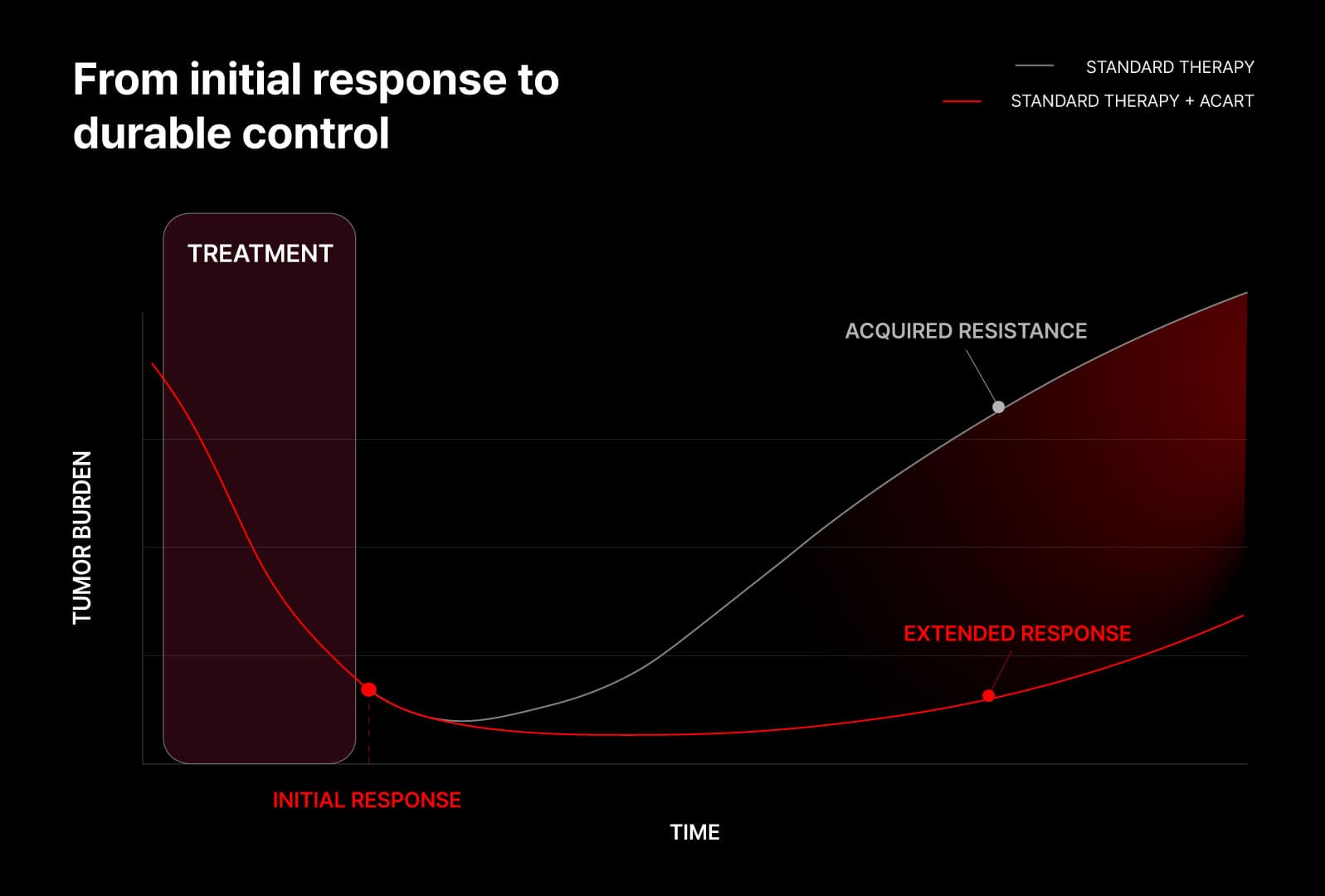
Kill the tumor. Block the comeback.
ACART focuses on the biology that persists after the initial response.
Current paradigm
Maximize cancer-selective cell killing.
Measure the depth of the initial response, often before the biology of residual cells is fully revealed.
ACART ambition
Extend patients’ survival by extending response durability.
Pair with the standard of care to intercept therapy-specific adaptive survival programs, delay resistance, and prolong disease control.
Resected NSCLC

Stage III Melanoma
Hepatocellular carcinoma
Muscle-invasive
bladder cancer
Esophageal cancer
Data summarized from published clinical literature and a 2025 systematic review in Frontiers in Oncology.
The ploidy cycle may be an engine of cellular adaptation and evolution.
Under therapeutic stress, a small fraction of cancer cells may transition into transient drug-tolerant, senescence-like, and polyploid states. Some can later generate proliferative progeny with stem-like and resistant features—creating a potential route from initial response to repopulation.
ACART working model
“Ploidy cycle” is used as a functional framework under active validation. Its prevalence, causal contribution, and clinical relevance are expected to vary by tumor type, genotype, therapy, and treatment schedule.

ACART working model
“Ploidy cycle” is used as a functional framework under active validation. Its prevalence, causal contribution, and clinical relevance are expected to vary by tumor type, genotype, therapy, and treatment schedule.
Biology of transient,
metastable cell states
Senescence escape, polyploidization, and meiosis-like reduction programs can reactivate developmental, germline, and oncofetal gene networks. These unconventional states may expose vulnerabilities that are not evident in routinely proliferating cancer cells—opening a distinct target space for anti-resistance therapy.
Each ACART intervention can therefore be matched to the tumor–therapy context that creates the adaptive state and paired with the standard therapy that induced it.
State entry
Drivers that permit escape from canonical mitotic checkpoints and entry into polyploidy.
State maintenance
Stress-tolerance, metabolic, DNA-repair, and survival programs that sustain persistent cells.
State exit
Mechanisms enabling ploidy reduction, senescence escape, and return to proliferation.
Relapse competence
Features that distinguish terminal polyploid cells from the rare subset capable of producing progeny.
RVNDL · Rivendell
AI-driven single-cell morpholomics and high-content screening.
RVNDL turns the ploidy cycle into a screenable, stage-resolved phenotype.
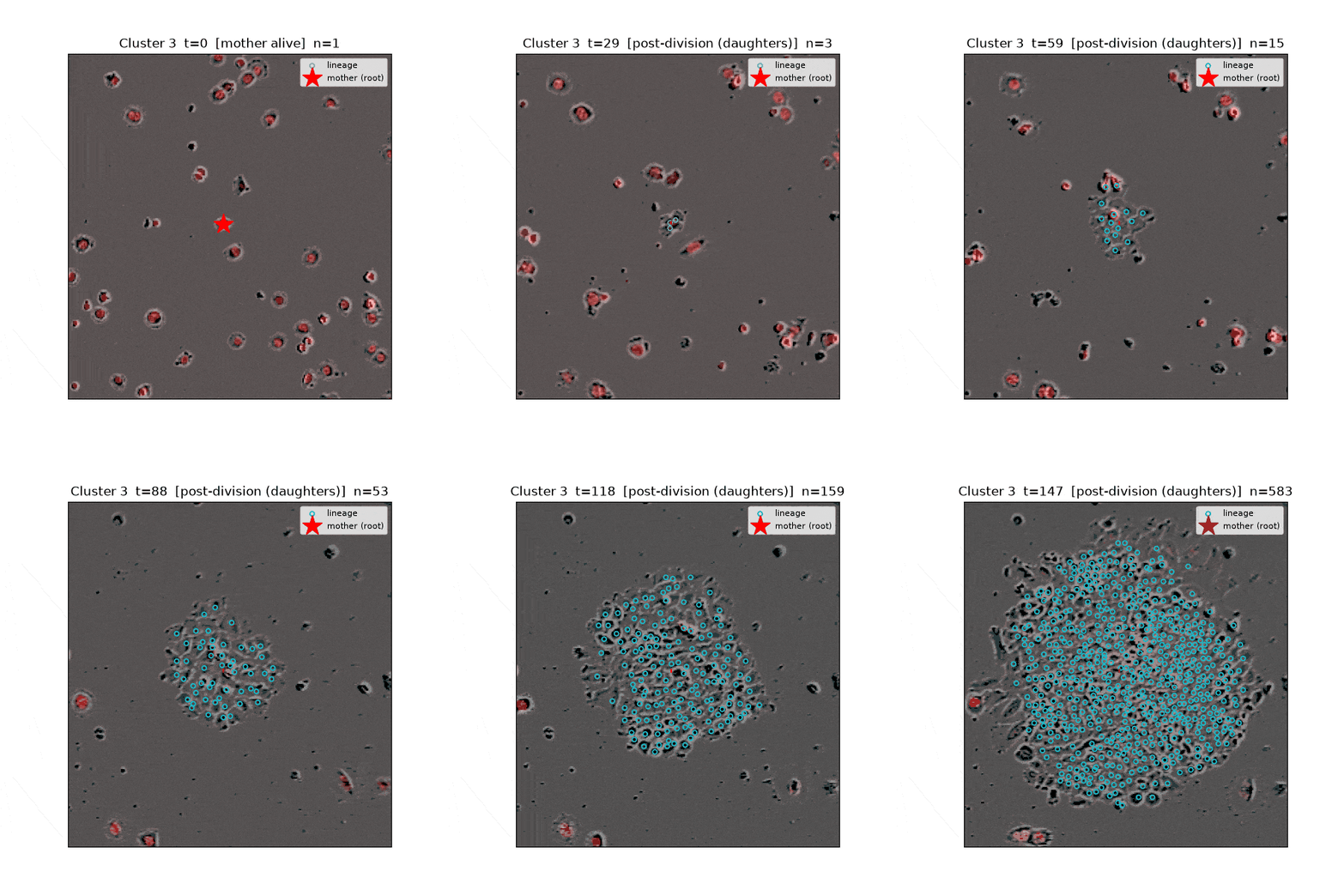
Therapy-induced polyploidization, persistence, reduction division, and repopulation are tracked longitudinally at single-cell resolution, while AI-assisted image analysis converts morphology and temporal behavior into quantitative cell-state trajectories.
Live · longitudinal · single-cell
See not only which cells survive, but how they survive—and whether they return.
Conventional endpoint viability can miss rare adaptive states. RVNDL follows the same biological process across treatment, persistence, washout, and recovery.

Temporal
State Transitions
Single-cell
Morpholomics
Functional
Repopulation
Stage-resolved
Mechanism
A journey from tumor–therapy context to an actionable hit
For a defined tumor and standard therapy, RVNDL interrogates large compound or target-hypothesis spaces and ranks interventions by durable suppression of repopulation—not acute cytotoxicity alone.
Recreate context
Model the relevant tumor genotype, standard therapy exposure, and recovery schedule.
Track the cycle
Capture live-cell morphology, DNA-associated features, survival, and state transitions over time.
Interrogate targets
Screen compound libraries and perturbation hypotheses across thousands of potential interventions.
Test durability
Use washout and recovery to distinguish temporary growth inhibition from durable repopulation control.
Resolve mechanism
Deconvolute hits by the stage of the ploidy cycle they disrupt and validate causal driver nodes.
Stage-of-action deconvolution
A hit is more useful when we know where it acts. RVNDL classifies intervention windows to guide schedule, mechanism, and combination design.
Prevent entry
Block therapy-induced transition into a polyploid or drug-tolerant persistent state.
Disrupt persistence
Target survival dependencies that maintain residual cells under or after therapeutic pressure.
Block re-emergence
Prevent ploidy reduction, cell-cycle re-entry, progeny formation, and post-treatment repopulation.
Navigating T³:
Tumor × Therapy × Target of resistance.
Resistance is not one disease. It is a context: the tumor, the therapy applied to it, and the adaptive dependency created by that therapy. Every RVNDL experiment adds a coordinate to this multidimensional resistance space.
Navigating T³ :
Tumor × Therapy × Target of resistance.
Each point represents a tumor–therapy condition; height indicates target of resistance.
Tumor
Lineage, genotype, baseline cell state, and the biological capacity to enter a therapy-persistent program.
Therapy
Mechanism, dose, duration, sequence, and the specific selective pressure that induces adaptation.
Target of resistance
Causal driver node, intervention window, biomarker, and the combination strategy most likely to extend response.
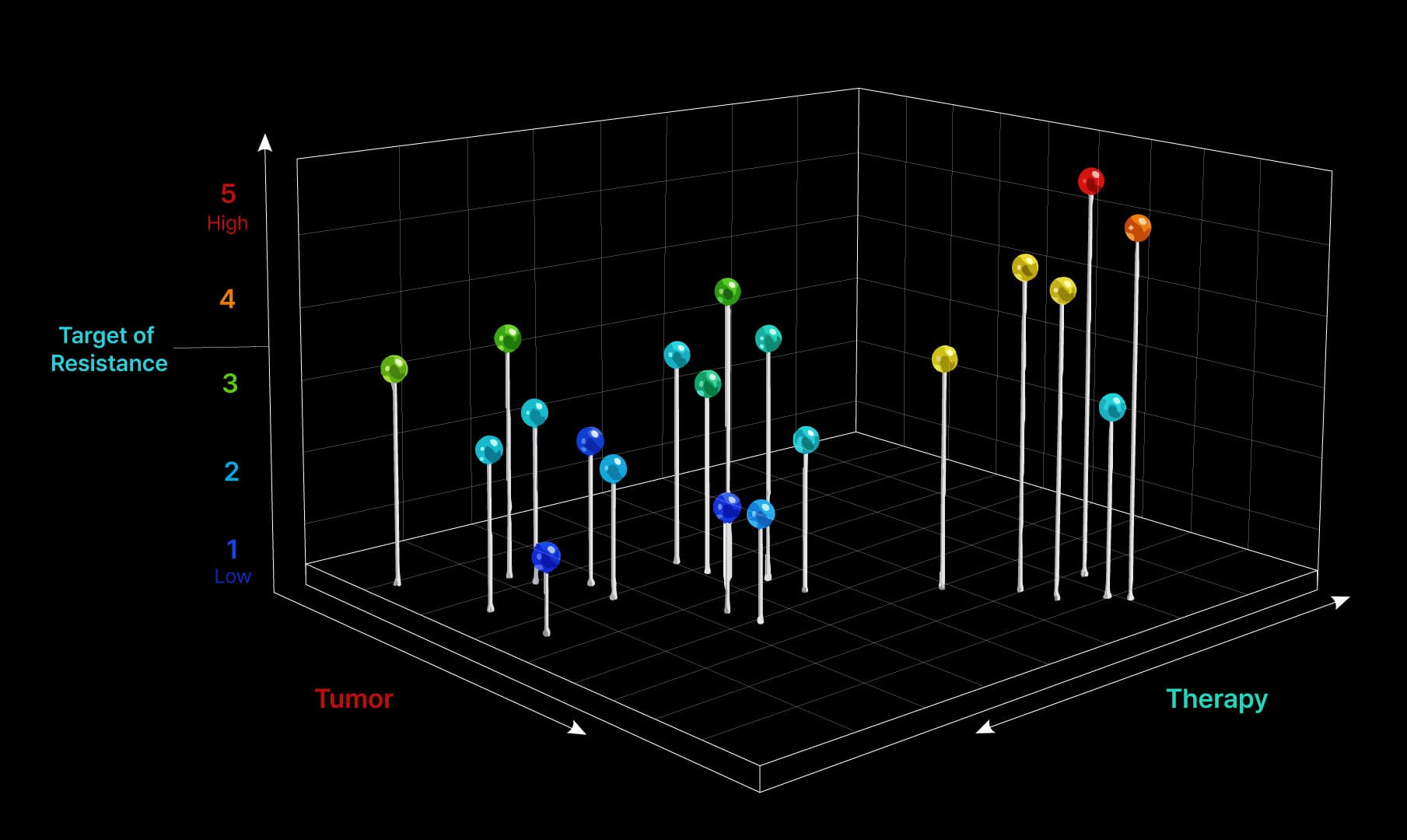
A resistance atlas in the making
As the map grows, ACART can distinguish context-specific combinations from convergent resistance nodes shared across cancers. The goal is to move from isolated screening hits to a queryable treatment strategy.
Tumor
Lineage, genotype, baseline cell state, and the biological capacity to enter a therapy-persistent program.
Therapy
Mechanism, dose, duration, sequence, and the specific selective pressure that induces adaptation.
Target of resistance
Causal driver node, intervention window, biomarker, and the combination strategy most likely to extend response.
Query 01.
For this tumor and therapy, which target best suppresses repopulation?
Query 02.
For this target, in which tumor–therapy contexts is it actionable?
Query 03.
Which adaptive dependencies recur across multiple resistance contexts?
The destination
Evidence-led.
Hypothesis-aware.
ACART investigates a working model in which therapy-persistent polyploid states contribute to repopulation in selected tumor–therapy contexts. Causality and clinical relevance are tested through longitudinal functional studies, recovery assays, and perturbational validation.
Important distinction
Drug-tolerant persister states, polyploid giant cancer cells, and whole-genome doubling can overlap, but they are not interchangeable concepts. RVNDL is designed to resolve their temporal and functional relationships rather than infer relapse competence from ploidy or morphology alone.