

Denfivontinib
Denfivontinib is a small-molecule dual inhibitor selectively targeting both FLT3 and AXL kinases, offering a differentiated therapeutic strategy applicable to both hematologic malignancies and solid tumors.
DEVELOPMENT STAGE
Phase 1 — Completed in relapsed/refractory AML and advanced solid tumors
Commercialized
AT A GLANCE
Target
FLT3 / AXL
Receptor tyrosine kinases involved in tumor-cell survival, proliferation, and therapeutic resistance
INDICATION
AML / Solid tumors
Patients with AML to be selected via a predictive biomarker-based strategy; patients with advanced solid tumors
MODALITY
Small molecule
Oral dual FLT3/AXL kinase inhibitor
Resistance and heterogeneity in AML support FLT3/AXL dual inhibition and biomarker-based patient selection
Acute myeloid leukemia (AML) is an aggressive and molecularly heterogeneous malignancy with high rates of treatment resistance and relapse. Although FLT3-targeted therapies have improved outcomes in FLT3-mutated AML, resistance frequently emerges through secondary FLT3 alterations, compensatory signaling pathways, and clonal evolution. AXL signaling can provide an additional survival and resistance pathway and has also been associated with tumor progression and resistance across AML and multiple solid tumors.
These complementary roles of FLT3 and AXL support a dual-targeting strategy aimed at suppressing both oncogenic signaling and adaptive resistance. Because treatment sensitivity in AML may not be fully defined by a single mutation, biomarker-based patient selection may also be important for identifying patients most likely to benefit from therapy.
Dual FLT3/AXL inhibition targeting oncogenic signaling and therapeutic resistance
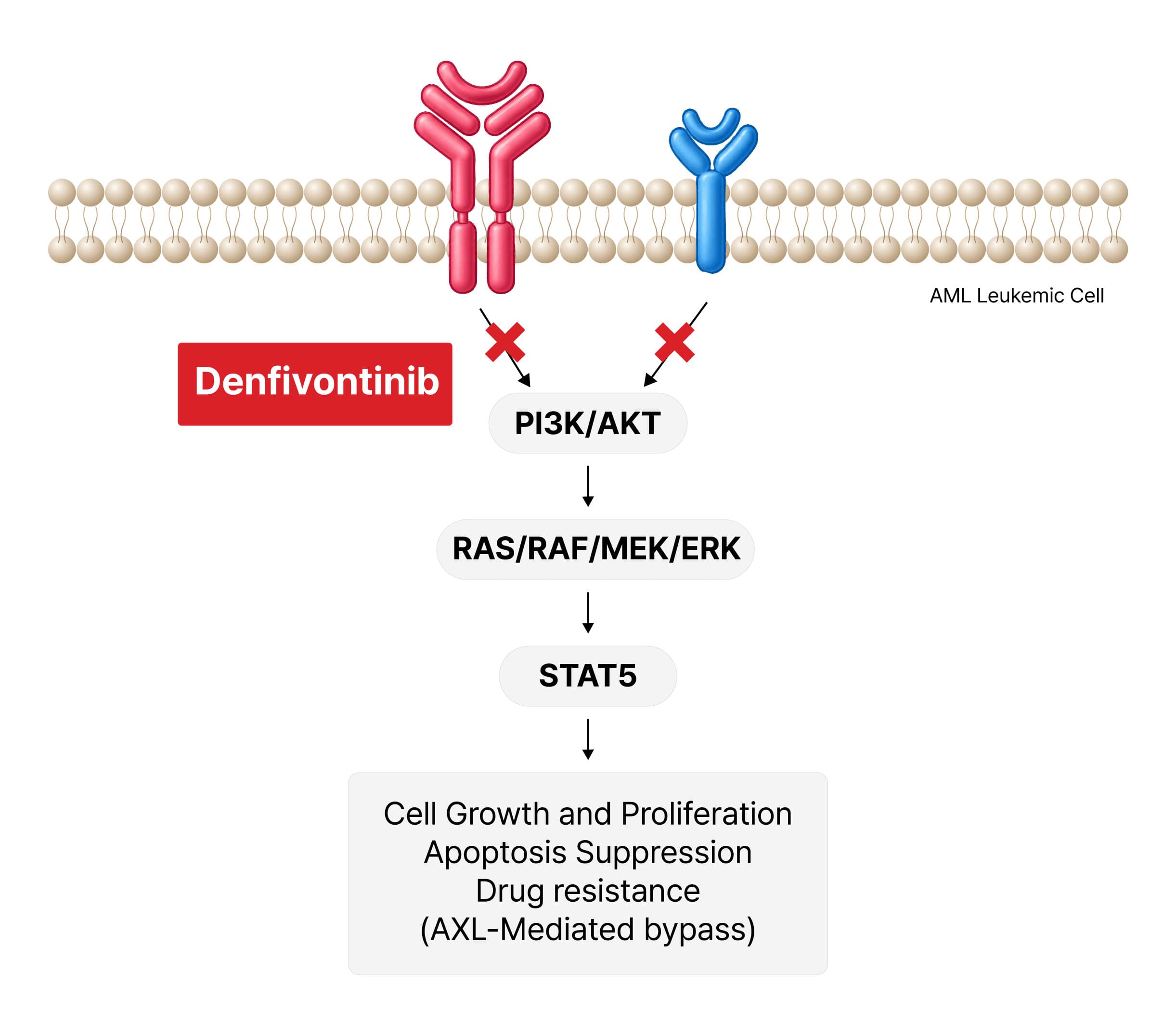
Denfivontinib is an oral small-molecule kinase inhibitor designed to simultaneously target FLT3 and AXL, two receptor tyrosine kinases implicated in tumor-cell survival, proliferation, and therapeutic resistance. In AML, activating FLT3 mutations drive oncogenic signaling that promotes leukemic-cell proliferation and survival, while AXL provides an additional survival and escape pathway associated with resistance to chemotherapy, targeted therapies, and immune-based treatments. By simultaneously inhibiting FLT3 andAXL, denfivontinib is designed to suppress both oncogenic driver signaling and compensatory resistance pathways that contribute to relapse and disease persistence. In preclinical studies, denfivontinib demonstrated potent activity against FLT3 mutant variants associated with relapse following prior FLT3 inhibitor therapy, anti-leukemic activity in AML patient-derived samples, and effective suppression of AXL signaling across multiple solid tumor models, together with immune-dependent anti-tumor effects. In collaboration with Yatiri Bio, a candidate biomarker profile associated with denfivontinib sensitivity beyond FLT3 mutation status is being further evaluated and validated to support biomarker-guided patient selection in future clinical trials.
Publications & Presentations
Preclinical
SKI‐G‐801, an AXL kinase inhibitor, blocks metastasis through inducing anti‐tumor immune responses and potentiates anti‐PD‐1 therapy in mouse cancer models
[Clin Transl Immunology. 2021 Dec 29;11(1):e1364.]
Preclinical
G-749, a novel FLT3 kinase inhibitor, can overcome drug resistance for the treatment of acute myeloid leukemia
[Blood · 2014;123(14):2209–2219 · Hee Kyu Lee, et al.]
Option agreement with YATIRI BIO
Global exclusive option to license · March 2026

Abbreviations — AML: acute myeloid leukemia · FLT3: FMS-like tyrosine kinase 3 · ITD: internal tandem duplication · TKD: tyrosine kinase domain · AXL: AXL receptor tyrosine kinase