

OCT-648
OCT-648 is a selective NUAK1 (NUAK family kinase 1) inhibitor program designed to modulate fibrosis-related YAP/TAZ signaling, with a lead focus on progressive CKD and AKI-to-CKD transition.
DEVELOPMENT STAGE
Preclinical — IND-enabling preparation
Commercialized
AT A GLANCE
Target
NUAK1
A kinase involved in fibrosis-related YAP/TAZ signaling and fibroblast activation
INDICATION
Fibrosis
Progressive CKD & AKI-to-CKD transition
MODALITY
Small molecule
Orally available, selective inhibitor
Fibrosis-driven disease progression remains a major therapeutic gap
Fibrosis is a common pathological process underlying progressive organ dysfunction across a range of chronic diseases. In the kidney, fibrosis is a central driver of the progressive loss of function seen in chronic kidney disease (CKD) across diverse etiologies. Current management relies primarily on standard-of-care treatments, including RAS inhibitors and SGLT2 inhibitors, together with blood pressure and glycemic control where appropriate. However, therapeutic options that directly target the fibrotic process remain limited, and many patients continue to progress toward end-stage renal disease, ultimately requiring dialysis or kidney transplantation.Patients with a history of acute kidney injury (AKI) are also at increased risk of subsequent CKD progression. This AKI-to-CKD transition is associated with maladaptive tissue repair, persistent tubular cell stress and fibrotic remodeling. Therapeutic approaches that modulate shared fibrosis-related mechanisms may therefore help slow CKD progression while offering potential relevance to other fibrosis-driven conditions, subject to further validation.
Selective NUAK1 inhibition to modulate fibrosis-related YAP/TAZ signaling
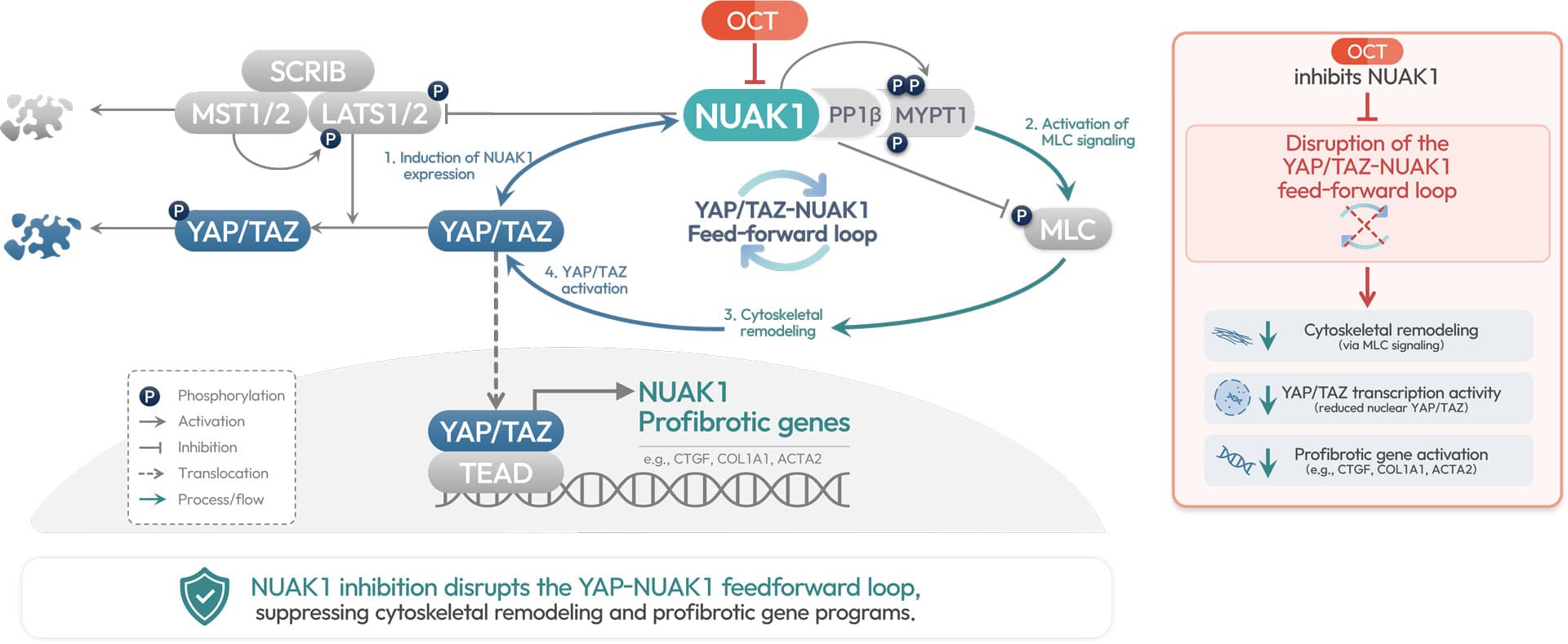
OCT-648 is a selective NUAK1 inhibitor program designed to disrupt a fibrosis-related YAP/TAZ-NUAK1 feed-forward loop. NUAK1 inhibition is expected to reduce cytoskeletal remodeling and YAP/TAZ transcriptional activity, thereby suppressing profibrotic gene expression and fibroblast activation. This mechanism may address shared fibrosis-driven disease processes, with progressive CKD and maladaptive repair following AKI as the lead development focus.
In nonclinical kidney fibrosis models, the NUAK1 inhibitor candidate series has demonstrated anti-fibrotic activity, including reductions in fibrotic area, fibroblast activation and collagen deposition, together with cellular target engagement and α-SMA modulation. Additional candidate optimization is ongoing to support the safety margin required for chronic kidney indications.
Publications & Presentations
Research on the OCT-648 NUAK1 inhibitor program
Preclinical
Development of Potent and Selective NUAK1 Inhibitors that Attenuate TGF-β–Induced and UUO-Driven Renal Fibrosis via YAP Pathway Modulation
ISN WCN 2026 · Poster P522 · Yoon J, et al.
Prof. Paola Romagnani laboratory
University of Florence, Italy

Abbreviations — CKD: chronic kidney disease · AKI: acute kidney injury · ESRD: end-stage renal disease · IND: investigational new drug · SoC: standard of care · NUAK1: NUAK family kinase 1 · YAP: Yes-associated protein · TAZ: transcriptional co-activator with PDZ-binding motif · α-SMA: alpha-smooth muscle actin